


What is the weight for a stock rim

New Member
Joined: Mar 2000
Posts: 432
Likes: 0
 Re: What is the weight for a stock rim
I guess ~20lbs (the sport package wheel + tire combo weight 43lbs). From the point of view of acceleration each lb of wheel/tire is equivalent to something like 1.5-2lbs of passenger weight.
Not a lot, unless you are racing.
Not a lot, unless you are racing.

AudiWorld Member

Joined: Apr 2000
Posts: 413
Likes: 0
Re: What is the weight for a stock rim
The impact of wheel mass upon acceleration can be much more significant than 1.5 to 2x sprung, non-rotating mass.
In addition to having to accelerate the mass of the wheel, the vehicle must also overcome the wheel's moment of inertia, which depends on the distribution of mass from its rotational center.
When comparing wheels, as the distribution of mass moves further from the center, the wheel becomes more resistant to changes in rotational speed. This is a function of the distribution of the mass times the radius squared.
It's too bad we don't see published values for both wheel weight and moment of intertia. It is hard enough to find weights for wheels offered by the Tire Rack, etc. I really don't know what the rule of thumb is, but I have seen people in these discussions use something like 1lb unsprung weight = 6 lbs and 1lb rotational weight = 15 lbs. Of course, to do so is to commit an oversimplification, but the impact of wheel weight on performance is significant. Otherwise, we wouldn't even be talking about wheel weight for this forum, and bicycle racers would be running heavy duty slicks on mountain bike rims in the Tour de France.
In addition to having to accelerate the mass of the wheel, the vehicle must also overcome the wheel's moment of inertia, which depends on the distribution of mass from its rotational center.
When comparing wheels, as the distribution of mass moves further from the center, the wheel becomes more resistant to changes in rotational speed. This is a function of the distribution of the mass times the radius squared.
It's too bad we don't see published values for both wheel weight and moment of intertia. It is hard enough to find weights for wheels offered by the Tire Rack, etc. I really don't know what the rule of thumb is, but I have seen people in these discussions use something like 1lb unsprung weight = 6 lbs and 1lb rotational weight = 15 lbs. Of course, to do so is to commit an oversimplification, but the impact of wheel weight on performance is significant. Otherwise, we wouldn't even be talking about wheel weight for this forum, and bicycle racers would be running heavy duty slicks on mountain bike rims in the Tour de France.
New Member
Joined: Mar 2000
Posts: 432
Likes: 0
I disagree, Tango
Look at this model. We have a certain torque [T] available at the wheels. The car mass is [m], the total moment of inertia of the wheels is [I], the radius of the wheels is [r], the total drag and rolling resistance is D (a force). What acceleration should we expect? Well, the torque available at the wheels is doing three things: (1) accelerating the linear movement of the car (linear acceleration [a]), (2) accelerating the rotation of the wheels (angular acceleration [w']) and opposing the drag, etc. The following equation describes the situation:
T = m*r*a + I*w' + D*r
If the tires are not slipping
w' = a/r
Replace in the first equation and moving things around
T/r - D = (m + I/r^2)*a
where r^2 mean "r squared". The left side of the equation is the force available for acceleration (i.e., the force available at the contact patch minus the drag, etc). That force causes an acceleration [a] on a "non-rotating equivalent mass" [e],
e = m + I/r^2
Now suppose we increase the mass of the wheels by an amount [x]; both the mass and the moment of inertia will increase, to m' and I' respectively.
Obviously
m' = m + x
What about I'; as you point out, the moment of inertia depends on the distribution of mass as a function of the distance from the axis of rotation. The very worst case, though, is to assume that all the increase [x] is located at the perifery of the wheel, that is, at a distance [r]. Then,
I' = I + x*r^2
As a result of the increase in wheel mass, the non-rotating equivalent mass is now
e' = m' + I'/r^2 = m + x + I + x = e + 2*x
I.e., the increase of wheel mass [x] produces an effect no worse than [2x] in equivalent mass.
T = m*r*a + I*w' + D*r
If the tires are not slipping
w' = a/r
Replace in the first equation and moving things around
T/r - D = (m + I/r^2)*a
where r^2 mean "r squared". The left side of the equation is the force available for acceleration (i.e., the force available at the contact patch minus the drag, etc). That force causes an acceleration [a] on a "non-rotating equivalent mass" [e],
e = m + I/r^2
Now suppose we increase the mass of the wheels by an amount [x]; both the mass and the moment of inertia will increase, to m' and I' respectively.
Obviously
m' = m + x
What about I'; as you point out, the moment of inertia depends on the distribution of mass as a function of the distance from the axis of rotation. The very worst case, though, is to assume that all the increase [x] is located at the perifery of the wheel, that is, at a distance [r]. Then,
I' = I + x*r^2
As a result of the increase in wheel mass, the non-rotating equivalent mass is now
e' = m' + I'/r^2 = m + x + I + x = e + 2*x
I.e., the increase of wheel mass [x] produces an effect no worse than [2x] in equivalent mass.
Trending Topics
AudiWorld Stories
Bringing Audi to Life for Audi Fans

10 Strangest Audi Designs That Actually Made Production
Joe Kucinski
2027 Audi Q7 and SQ7: Audi Upgraded EVERYTHING!
Michael S. Palmer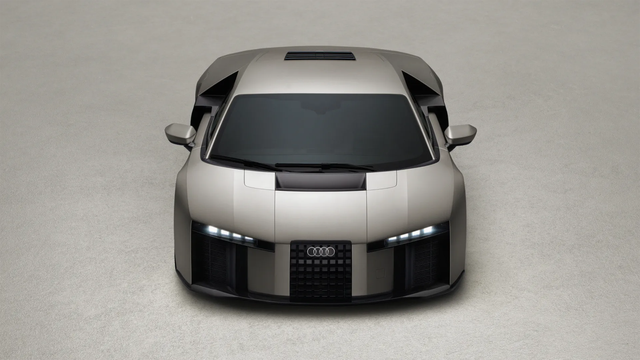
Audi Unveils Absurdly Cool New Supercar: 10 Things You Need to Know!
Verdad Gallardo
The Highs & Lows of Every Audi C-Class Generation
Joe Kucinski
Top 10 Most Expensive Audis Ever Sold on Bring-A-Trailer
Brett Foote
10 Audi Features & Options We Miss the Most!
Joe Kucinski
Audi Recreates Crazy-Looking Speed Record Breaker From 1935
Verdad Gallardo
Coachbuilder Recreates the 1995 Audi TTS Concept
Verdad Gallardo
Every Audi V10 Car Ranked!
Joe Kucinski
New Member
Joined: Mar 2000
Posts: 388
Likes: 0
But if e=mc2,
..then how could the rotational pull of the sun have any effect on the inertia of the gravitational forces which drive the velocity of how quickly I spent $$$$$ on those wheels?
Did I mention I almost failed my Physics Regents in high school?
Did I mention I almost failed my Physics Regents in high school?