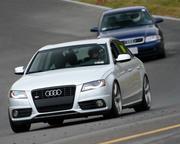
I have a couple questions about how to take a few turns at Mont Tremblant

Thread Starter
AudiWorld Super User
Joined: May 2003
Posts: 19,080
Likes: 0
 I have a couple questions about how to take a few turns at Mont Tremblant
<a href="http://www.lecircuit.com/en/media/track_eng.pdf"> Track map</a>
Into turn 4 of the esses I would take a really late apex so I would be lined up with the curb for turn 5. My car would understeer like crazy coming out of 5. I would be off the gas after the apex and almost went off the track by the rumble strips a few times. My instructor kept telling me not to brake for it and to stay on the gas the whole time but it seems like that would exaggerate the understeer even more by shifting weight off the front tires.
I tried experimenting with a bit of trail braking but the day was over pretty soon and I didnt get enough attempts at it. The few attempts I did make seemed to make a difference. I'm not sure if it was from entering at a lower speed or because of the shift in weight...or maybe both. Is there any preferred way to take this turn?
The next spot I was a little unclear on was at turn 10. Should that be a late apex or a regular apex?
Lastly, is there any difference between a car rotating and oversteering?
Into turn 4 of the esses I would take a really late apex so I would be lined up with the curb for turn 5. My car would understeer like crazy coming out of 5. I would be off the gas after the apex and almost went off the track by the rumble strips a few times. My instructor kept telling me not to brake for it and to stay on the gas the whole time but it seems like that would exaggerate the understeer even more by shifting weight off the front tires.
I tried experimenting with a bit of trail braking but the day was over pretty soon and I didnt get enough attempts at it. The few attempts I did make seemed to make a difference. I'm not sure if it was from entering at a lower speed or because of the shift in weight...or maybe both. Is there any preferred way to take this turn?
The next spot I was a little unclear on was at turn 10. Should that be a late apex or a regular apex?
Lastly, is there any difference between a car rotating and oversteering?

Junior Member
Joined: Nov 2000
Posts: 768
Likes: 0
hmm
It's hard to really tell without having been in the car. Generally, though, the solution to excessive understeer does not involve more throttle.
Most likely, some combination of the following would do the trick.
- Less entry speed
- Lift or tap the brakes at turn in to shift weight foward and help the front tires bite.
- be more gradual on the throttle after turn in -- wait to get more of the turning done first
- time the right to left transition better. In those esses, you build up a lot of potential energy on left side in the compressed springs in first turn; ideally, you can time your turn in to the second part so that you unleash that energy and flick the car around the other way. Make sure you have an instructor the first time you try this.
The inside curb in turn 5 is also easy to climb on, and can help you turn if you get comfortable hopping it.
Turn 10 should be a somewhat late apex; you don't track out all the way so you can come back over to the right to set up for turn 11. does that make sense?
Finally, rotation doesn't equal oversteer. If you're approaching a 90 degree corner, you need to rotate the car's *momentum* by 90 degrees to stay on the track. When you hear people talk about "helping the car rotate" they're just describing tricks to help you accomplish that change in momentum as economically as possible. Some of the ideas in my list above are techniques to help the car rotate, but have nothing to do with oversteer.
Oversteer and understeer are basically just describing where the car is pointing in relation to the car's momentum.
Hope this helps!
Most likely, some combination of the following would do the trick.
- Less entry speed
- Lift or tap the brakes at turn in to shift weight foward and help the front tires bite.
- be more gradual on the throttle after turn in -- wait to get more of the turning done first
- time the right to left transition better. In those esses, you build up a lot of potential energy on left side in the compressed springs in first turn; ideally, you can time your turn in to the second part so that you unleash that energy and flick the car around the other way. Make sure you have an instructor the first time you try this.
The inside curb in turn 5 is also easy to climb on, and can help you turn if you get comfortable hopping it.
Turn 10 should be a somewhat late apex; you don't track out all the way so you can come back over to the right to set up for turn 11. does that make sense?
Finally, rotation doesn't equal oversteer. If you're approaching a 90 degree corner, you need to rotate the car's *momentum* by 90 degrees to stay on the track. When you hear people talk about "helping the car rotate" they're just describing tricks to help you accomplish that change in momentum as economically as possible. Some of the ideas in my list above are techniques to help the car rotate, but have nothing to do with oversteer.
Oversteer and understeer are basically just describing where the car is pointing in relation to the car's momentum.
Hope this helps!

Junior Member
Joined: Jan 2003
Posts: 668
Likes: 0
Agree with mirth...
Seems like your entry speed is too fast if you are understeering there. Maybe your instructor wanted you to let the suspension "settle" after Turn 4 and then apply maintenance throttle through Turn 5 to keep the car planted. If you're lifting at the apex of Turn 5, you're losing precious momentum ahead of a fast section of the track...
Regarding Turn 10, it's a late apex. You really should attack that curbing there. If you do a track walk, you'll see where all the paint is missing from the racers. You literally should drive over the last bit of the curbing as you get parallel to set up for Turn 11.
Regarding Turn 10, it's a late apex. You really should attack that curbing there. If you do a track walk, you'll see where all the paint is missing from the racers. You literally should drive over the last bit of the curbing as you get parallel to set up for Turn 11.

AudiWorld Super User
Joined: Jun 2001
Posts: 2,542
Likes: 1
Go a little slower through 4...
Yeah, looking at mirth's post, that's reasonable... I do some throttle lift to get enough rotation for the turn-in to 5, in the Mini. THat lift is BEFORE, not AT, the apex. I'm back on the throttle by the apex.
I generally 'pause' a little up on the right-hand turtles in 4 to let the car settle; the Mini is tail-happy enough that any sort of flick would probably be disastrous.
As for turn 10, people have different opinions; I really like a late apex there; my apex is actually the very last bit of the turtle as it drops back towards the pavement. I then do not track out but instead stay to the right until turn-in for turn 11 (the left-hander). This works because I carry a LOT of speed through turn 10, and would not have time to get back to the right if I had to track out from it.
I generally 'pause' a little up on the right-hand turtles in 4 to let the car settle; the Mini is tail-happy enough that any sort of flick would probably be disastrous.
As for turn 10, people have different opinions; I really like a late apex there; my apex is actually the very last bit of the turtle as it drops back towards the pavement. I then do not track out but instead stay to the right until turn-in for turn 11 (the left-hander). This works because I carry a LOT of speed through turn 10, and would not have time to get back to the right if I had to track out from it.
Junior Member
Joined: Nov 2000
Posts: 768
Likes: 0
agree about 10 , except
that I suspect the absolute fastest line through 10 and 11 involves a a slightly earlier apex than you describe, and tracking out somewhat between 10 & 11 -- maybe 2/3 of the way across the track, and then coming back over partway to the right before turning in for 11. maybe when I get home I can dig up some video.
remember that the short uphill straight after 11 is more or less a throwaway; there's little to be gained by being all the way to the right on turn in. So tracking out part way in 10 gives you a bigger radius, therefore more speed through 10, which is the longest part of that sequence. and it also means you don't have to take as much off under braking...
wdyt?
remember that the short uphill straight after 11 is more or less a throwaway; there's little to be gained by being all the way to the right on turn in. So tracking out part way in 10 gives you a bigger radius, therefore more speed through 10, which is the longest part of that sequence. and it also means you don't have to take as much off under braking...
wdyt?
AudiWorld Super User
Joined: Jun 2001
Posts: 2,542
Likes: 1
But after 11 is an uphill
Therefore you bleed off speed, ceteris paribus, therefore it takes longer so it's equivalent to a longer straight. If you look at how much *time* you spend between 10 and 11, and between 11 and 12, you spend more between 11 and 12.
However, you're right about tracking out partway... now that I think about it, I don't stay *completely* to the right... I track out maybe 1/3 of the way.
However, you're right about tracking out partway... now that I think about it, I don't stay *completely* to the right... I track out maybe 1/3 of the way.

New Member
Joined: Feb 2005
Posts: 26
Likes: 0
questions about Mont Tremblant
if you get so much understeer out of 5 that you have to back off, you're either coming in too fast or using the wrong line (early apex).
For turn 4 I slow right down, entering from the middle of the track and turning in late. I apex about 25 feet before and 10 feet outside the true middle of the curve. I "exit" just past the middle of the curve, running parallel to the rumble strip all the way to the inside (right side). Normally I'll have with my passenger side wheels on the rumble strip.
I keep the car straight for about 20 feet to stabilize it, then turn in for 5. I use a slightly late apex. If the car tends to understeer, I run the driver's side wheels all the way to the edge of the inside rumble strip; when you come off the rumble strip, the rear end gets unsettled and that helps bring you around. Inexperienced drivers DO NOT try this especially if your car is neutral or oversteers - you WILL spin.
Look at the darker line on the link you provided, you'll see what I mean.
For turn 10 I use a slightly late apex, runnng all the way over the inside curbing and letting the car drift out to about 1/2 track. Try taking it in 4th if you can, most of the time an extra downshift to 3rd just lengthens your braking distance without any advantage on the exit.
For turn 4 I slow right down, entering from the middle of the track and turning in late. I apex about 25 feet before and 10 feet outside the true middle of the curve. I "exit" just past the middle of the curve, running parallel to the rumble strip all the way to the inside (right side). Normally I'll have with my passenger side wheels on the rumble strip.
I keep the car straight for about 20 feet to stabilize it, then turn in for 5. I use a slightly late apex. If the car tends to understeer, I run the driver's side wheels all the way to the edge of the inside rumble strip; when you come off the rumble strip, the rear end gets unsettled and that helps bring you around. Inexperienced drivers DO NOT try this especially if your car is neutral or oversteers - you WILL spin.
Look at the darker line on the link you provided, you'll see what I mean.
For turn 10 I use a slightly late apex, runnng all the way over the inside curbing and letting the car drift out to about 1/2 track. Try taking it in 4th if you can, most of the time an extra downshift to 3rd just lengthens your braking distance without any advantage on the exit.
Trending Topics
Junior Member
Joined: Nov 2000
Posts: 768
Likes: 0
true
but there's still only something like 50 yards between track out and starting to brake for 12.
I think it also depends a lot on the car. In my car, I'll carry enough speed through 10 that I'm forced to track out part way across the track; I might not make it all the back over the right, but I don't really have to slow down at all for 11. In other words, my bottleneck through that segment is turn 10. I don't have the impression that a tighter radius through 10 would result in more speed through 11.
If I were lifting a lot or braking for 11, it would be a different story.
For cars with more power or different handling, there's probably a different answer.
I think it also depends a lot on the car. In my car, I'll carry enough speed through 10 that I'm forced to track out part way across the track; I might not make it all the back over the right, but I don't really have to slow down at all for 11. In other words, my bottleneck through that segment is turn 10. I don't have the impression that a tighter radius through 10 would result in more speed through 11.
If I were lifting a lot or braking for 11, it would be a different story.
For cars with more power or different handling, there's probably a different answer.
AudiWorld Stories
Bringing Audi to Life for Audi Fans

10 Strangest Audi Designs That Actually Made Production
Joe Kucinski
2027 Audi Q7 and SQ7: Audi Upgraded EVERYTHING!
Michael S. Palmer
Audi Unveils Absurdly Cool New Supercar: 10 Things You Need to Know!
Verdad Gallardo
The Highs & Lows of Every Audi C-Class Generation
Joe Kucinski
Top 10 Most Expensive Audis Ever Sold on Bring-A-Trailer
Brett Foote
10 Audi Features & Options We Miss the Most!
Joe Kucinski
Audi Recreates Crazy-Looking Speed Record Breaker From 1935
Verdad Gallardo
Coachbuilder Recreates the 1995 Audi TTS Concept
Verdad Gallardo
Every Audi V10 Car Ranked!
Joe Kucinski
AudiWorld Super User
Joined: Jun 2001
Posts: 2,542
Likes: 1
Well, the Mini does have rather different characteristics from your car ;)
Though it is pretty tail-happy on trail-braking, it just understeers under throttle. However, I don't need much of a braking zone for the bridge turn.