


Twin-turbo functionality

Thread Starter
AudiWorld Super User
Joined: Aug 2001
Posts: 2,809
Likes: 0
 Twin-turbo functionality
I was at the dealer Friday (new steering pump) and had a conversation about extended warranties. (They're going to send me theirs, and I'll report back. It looks like a good deal, at first blush).
As part of the conversation I mentioned the concern that's been discussed here and on the A6 forum about getting both turbos replaced (per Audi specs) should one go.
He nodded wisely and said something like "oh, yes, that's because it's a two-stage system." This was not a service tech, though.
Now, I had this naive idea that the two little turbos in the 2.7T were sort of assigned in parallel to the two banks of 3 cylinders. This "stage" comment, though, implies that they're in-line, first one pumps it up a little and second one pumps it up more and feeds all 6 cylinders.
Anybody know which it really is? HPH
As part of the conversation I mentioned the concern that's been discussed here and on the A6 forum about getting both turbos replaced (per Audi specs) should one go.
He nodded wisely and said something like "oh, yes, that's because it's a two-stage system." This was not a service tech, though.
Now, I had this naive idea that the two little turbos in the 2.7T were sort of assigned in parallel to the two banks of 3 cylinders. This "stage" comment, though, implies that they're in-line, first one pumps it up a little and second one pumps it up more and feeds all 6 cylinders.
Anybody know which it really is? HPH

AudiWorld Super User
Joined: Mar 2000
Posts: 13,495
Likes: 0
This is similar to what I've been told, only my salesman said that instead of
being staged per se (one feeding the other), that they both feed all six cylinders, only one is doing it alone at low RPM while they're both pumping air at higher RPM.

AudiWorld Super User
Joined: Jul 2001
Posts: 2,445
Likes: 1
From: Arvada, CO
It is pretty obvious if you look at a diagram of the system.
It is NOT a sequential (series) system, but rather a parallel system.
The intake out of the MAF is split by the Y pipe on the top of the engine. This feeds each of the two matched (very important) turbos. The turbos are driven off of the exhaust from their respective bank of cylinders, compressing the air which flows back up to the infamous Throttle Body Boot, through the throttle body and into the intake manifold where each cylinder is fed.
The layout of a V6 does not lend itself to a sequential setup mostly because of the plumbing. The only production cars that I believe have had sequential systems are the last generation Toyota Supra (inline 6) and the last RX7 turbo (rotary). In a sequential system, one large turbo feeds the second small turbo. The advantage is that you get decent response from the second turbo, which pulls through the large first stage turbo at low RPMs, as well as the better top end provided by the high flow characteristics of the large first stage. Because the first stage is feeding compressed air into the second stage small turbo, the second stage turbo will not overspin.
With a parallel system, you are limited by the sum of the flow provided by the two small turbo, which must be sized to provide quick spool up at the bottom end and reasonable flow at the top end. That is the trade off, turbo lag vs. top end performance.
HTH!
The intake out of the MAF is split by the Y pipe on the top of the engine. This feeds each of the two matched (very important) turbos. The turbos are driven off of the exhaust from their respective bank of cylinders, compressing the air which flows back up to the infamous Throttle Body Boot, through the throttle body and into the intake manifold where each cylinder is fed.
The layout of a V6 does not lend itself to a sequential setup mostly because of the plumbing. The only production cars that I believe have had sequential systems are the last generation Toyota Supra (inline 6) and the last RX7 turbo (rotary). In a sequential system, one large turbo feeds the second small turbo. The advantage is that you get decent response from the second turbo, which pulls through the large first stage turbo at low RPMs, as well as the better top end provided by the high flow characteristics of the large first stage. Because the first stage is feeding compressed air into the second stage small turbo, the second stage turbo will not overspin.
With a parallel system, you are limited by the sum of the flow provided by the two small turbo, which must be sized to provide quick spool up at the bottom end and reasonable flow at the top end. That is the trade off, turbo lag vs. top end performance.
HTH!

Junior Member
Joined: Aug 2002
Posts: 602
Likes: 0
Perhaps a diagram might help :)
First the dual turbo set-up on the 2.7T petrol
<img src="http://pictureposter.audiworld.com/42103/2.7t-01.jpg">
Second, the single turbo set-up on the 2.5tdi diesel
<img src="http://pictureposter.audiworld.com/42103/2.5tdi-01.jpg">
Someone else can explain them !!!
Just my €0.02.
<img src="http://pictureposter.audiworld.com/42103/2.7t-01.jpg">
Second, the single turbo set-up on the 2.5tdi diesel
<img src="http://pictureposter.audiworld.com/42103/2.5tdi-01.jpg">
Someone else can explain them !!!
Just my €0.02.
Trending Topics
Junior Member
Joined: Aug 2002
Posts: 602
Likes: 0
OK then - explanation.
On the petrol engine, you can clearly see that on one bank of 3 cylinders, that the exhaust gasses drive the turbocharger who's impeller draws ambient air from the primary air intake, through the air filter, sends it on it's merry way through one of the intercoolers, and on to the inlet manifold of the same 3 cylinders, monitored by a pressure valve/wastegate who should blow-off excess pressure back to the primary air intake, seemingly totally independant of what's going on over on the other side of the engine, which should be doing basically the same, totally independantly.
There are a lot of do-daas around the turbocharger associated with exhaust gas recirculation, which is needed to comply with emission standards, but not essential to the running of the engine.
It would probably be better without it,
but not for the environment.
I'll shut up now.
Best wishes.
There are a lot of do-daas around the turbocharger associated with exhaust gas recirculation, which is needed to comply with emission standards, but not essential to the running of the engine.
It would probably be better without it,
but not for the environment.
I'll shut up now.
Best wishes.
AudiWorld Stories
Bringing Audi to Life for Audi Fans

2027 Audi Q7 and SQ7: Audi Upgraded EVERYTHING!
Michael S. Palmer
Audi Unveils Absurdly Cool New Supercar: 10 Things You Need to Know!
Verdad Gallardo
The Highs & Lows of Every Audi C-Class Generation
Joe Kucinski
Top 10 Most Expensive Audis Ever Sold on Bring-A-Trailer
Brett Foote
10 Audi Features & Options We Miss the Most!
Joe Kucinski
Audi Recreates Crazy-Looking Speed Record Breaker From 1935
Verdad Gallardo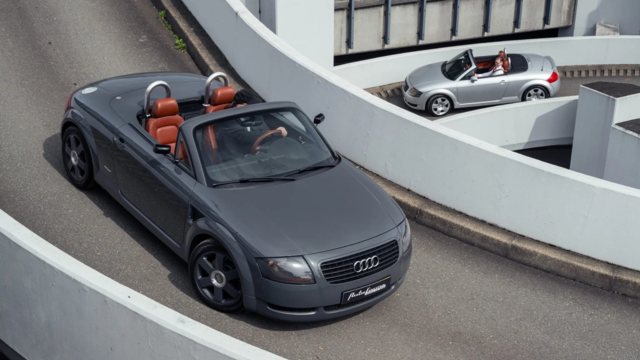
Coachbuilder Recreates the 1995 Audi TTS Concept
Verdad Gallardo
Every Audi V10 Car Ranked!
Joe Kucinski
9 Audi Designs That Aged Like Fine Wine
Verdad Gallardo
Thread
Thread Starter
Forum
Replies
Last Post
pdicustoms
A6 / S6 (C5 Platform) Discussion
9
May 9, 2005 10:51 AM
Muhammad
A6 / S6 (C5 Platform) Discussion
14
Mar 17, 2004 10:31 PM
savantsleeper
S4 / RS4 (B5 Platform) Discussion
12
Feb 19, 2003 12:18 PM
Stoney
A6 / S6 (C5 Platform) Discussion
17
Sep 4, 2000 09:13 AM
