The New Audi A8: A New Sporting Dimension in the Luxury Segment
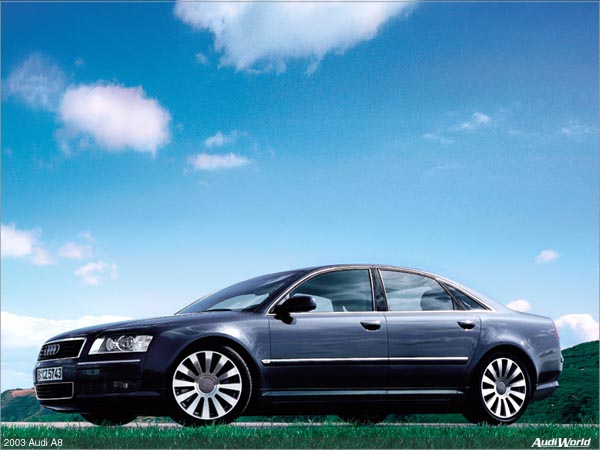
Audi is moving into the fast lane in the exclusive car class: with the new A8, the brand with the four-ring badge is unveiling a new sporting dimension in the luxury segment. A vehicle whose dynamic potential and trendsetting technology pave the way for an automotive experience that sets a new benchmark even in this competitive field of superlative calibre. Powerful V8 engines, the new 6-speed tiptronic and the low weight of the aluminium body result in superior road performance. The new Audi A8 has air suspension with aluminium running-gear components as standard, for an optimum configuration in every driving situation: by means of the continuously variable damper settings the adaptive air suspension reduces body movements, while optimising roadholding and ride comfort. Together with quattro permanent four-wheel drive, the A8 thus offers dynamic qualities that are entirely in keeping with its sporty character. The A8 is the ultimate driver’s car not simply by virtue of its outstanding dynamic behaviour. In the luxurious interior, the driver will find an entirely new approach to interacting with the vehicle’s systems, in the guise of the Multi Media Interface (MMI). Ingenious ergonomics and a logical, intuitively understandable operating concept reduce the driver’s workload and allow him to devote maximum attention to what matters – the business of driving, which of course includes savouring the uncommon pleasure of being behind the wheel of an A8. As the flagship of the Audi brand, the new A8 unconditionally embodies the identity of the future Audi generation: the driving experience is characterised by consistent athleticism and clear design, innovative technological systems and the highest standard of quality. All these characteristics embody Audi’s proverbial philosophy of “Vorsprung durch Technik” – or advancement through technology. The design The exterior Even at a glance, the flowing outlines of the new A8 make the overall character of this 5.05-metre long, 1.89-metre wide and 1.44-metre high saloon perfectly clear. It is a harmonious blend of clarity, sports appeal, agility and elegance. The flat front end with strikingly short overhang, a high, imposing tail end and the pronounced wedge shape of the new A8 lend it an overtly dynamic architecture. When viewed from a distance, the car’s crouched silhouette and shoulder line rising sharply to the rear convey an impression of extreme compactness. Only on approaching the vehicle does the body reveal the necessary dimensions to qualify as a prestigious saloon. As is typical of an Audi, the design of the new A8 depends crucially on the rejection of all superfluous design elements. Expansive, arching surfaces are bordered by clear lines in a tantalising formal interplay. Viewed from the front, the A8 combines evolutionary versions of typical Audi elements such as the broad double grille with entirely new, distinctive features. The marked tapering of the transition between the radiator grille and the side sections consequently reflect the characteristic dynamism of the new saloon. And the clear-glass covers on the flat, broad headlights mean that the tubular light units are visible, consciously transforming these technical components into design elements. Viewed side-on, the fact that the car’s centre of gravity is placed well back from the middle appears to urge the vehicle forwards even when stationary. Meanwhile the trapezoidal geometry of the vehicle’s bulk when viewed from the rear accentuates the low visual focal point. The Audi A8’s contours thus seem to hug the road surface, another reflection of its sports car connotations. This effect is further reinforced by the high position of the rear light units. Taking the form of broad bands, they moreover connect the side section with the rear end. Their covers again conceal new technical features: the rear lights are fitted with responsive, high-luminosity LED units.
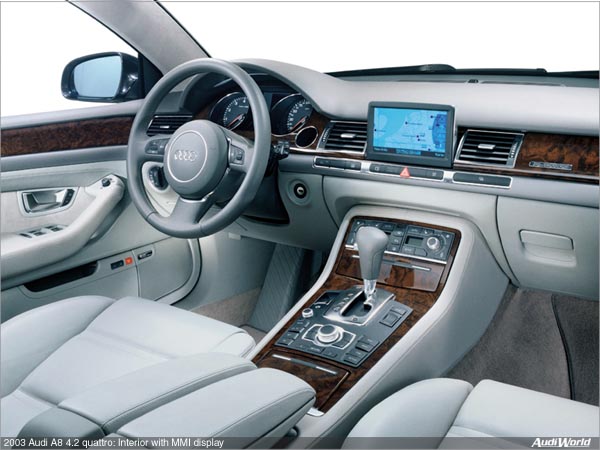
Interior The interior of the new A8 is also visibly and palpably characterised by sportiness, elegance and sensuality. The interior has a flair that stems from its meticulous design, superlative-quality materials and perfect craftsmanship. The Audi A8 is a driver’s car – a fact that is apparent even from a mere glance at its interior. It is characterised by the driving area’s neat, driver-oriented overall design. The central architectural features are the high centre console – reminiscent of a sports car – incorporating the MMI terminal, with its retractable display in the instrument panel. A clear join separates the centre console from the instrument panel: this is a clear indication of the departure from the classic cockpit look with a vast expanse of control and display elements scattered all over the place. The actual control centre of the new A8, comprising the MMI terminal and the controls for the air conditioning, is situated around the gear lever. All control elements are clearly identifiable and easy to reach. During operation the driver can keep his arm on the ergonomically redefined armrest. Thanks to MMI and the lack of a conventional handbrake lever, the design of both the centre console and the instrument panel is kept neat and expansive. The dynamic profile and the instrument panel’s emphasis on horizontal lines also convey a very immediate impression of physical lightness. The smooth transition between the instrument panel and the top shoulder is another feature that is typical of Audi. This line, structured by a two-section trim insert, continues as far as the rear compartment, creating a new sense of spaciousness. Depending on the choice of materials, the interior can be given a touch of sportiness or a tastefully elegant direction. Another equally unmistakable sign of change in the Audi A8 is the new generation of multifunctional steering wheels. There is a 4-spoke multifunctional leather steering wheel as standard, together with the optional version of a sporty 3-spoke design, again trimmed in leather. Both steering wheels have touch keys and menu roller controls by means of which the driver conducts the dialogue with the communication systems. The keys and rollers are a particularly convenient way of operating the audio system and the telephone, for example, without having to take a hand off the steering wheel. As an option, the steering wheel can also be equipped with shift paddles for operation of the tiptronic – an operating principle that has already proven its worth in the three-times Le Mans winner, the Audi R8. The driver can change gear when cornering, without having to take his hands off the steering wheel. The instrument panel, with large circular tubular-look instruments and a central, high-resolution LED display, is visible through the steering wheel. Its flat hood appears to be a natural extension of the engine lid, establishing a unity between the lines of the interior and exterior. There are three new versions of seat available, developed specifically for the A8, to match the various specifications and thus ensure a harmonious interior appearance. To permit this, for the first time Audi’s Design Department supervised the seat development process from the very outset. The electrically adjustable standard seats with active head restraints combine perfect long-distance comfort with good lateral support and maximum safety. Qualities from which the rear occupants likewise benefit. In addition to the basic version, sport and comfort versions are available as options, with electric seat depth and upper backrest adjustment. This latter feature makes it possible to angle the top two thirds of the backrest, to make it easier to rest the shoulders against it. Another new feature is the seat depth adjustment which dispenses with the otherwise inevitable gap between the seat surface and thigh support. The seat foam and upholstery are both drawn out as the rails move forward, creating the impression that the seat is getting longer. An electrically adjustable lumbar support and a seat memory function for the driver and front passenger are in addition available for all seat versions. Made-to-measure interior lighting The A8’s interior lighting can be dimmed steplessly as part of the optional interior lighting package with ambience lighting. The driver now has the option of calling up lighting constellations with individually adjustable brightness that are tailored to specific situations – such as urban roads or unlit motorways – via the MMI. This strategy makes it easier for the eye to adapt to contrasting light conditions inside and outside the car. Operating reliability is also increased thanks to the fact the switches can be found better and more quickly in all areas. The interior’s design and its high-quality materials can moreover consciously be appreciated after dark, without this impairing driving safety through any glare or reflections in the windows. In addition to the inside lights at roof level, there are light sources in the door trim panels and footwell. For this purpose Audi has used so-called electroluminescent films in the door trims for the first time. These not only occupy a minimum of space, they are also noted for their absolutely homogeneous light distribution. The colour of the lighting is coordinated so that, in combination with the symbol illumination and the instrument cluster, a harmonious overall impression is produced. This by no means follows physiological principles only, it is also in keeping with aesthetic requirements: the night design of the new Audi A8 also identifies it as a trendsetting representative of the luxury segment. Climate control There are two versions of climate control system to choose from for the new Audi A8: the optimised automatic air conditioning with separate controls for either side of the car, sun sensor and moisture management, and a new automatic air conditioning system with four-zone control. The latter version enables rear passengers to adjust their desired temperature and air distribution via a separate operating unit at the rear. The standard automatic air conditioning already affords a superb standard of comfort and convenience. Compared with the predecessor model, Audi’s developers have further improved both the system’s acoustics and the draught-free configuration. There are two additional air outlets integrated into the instrument panel, through which the necessary amount of air is distributed without a noticeable level of air movement for passengers. The ventilation for the rear passengers is from vents in the B-post, in the rear section of the centre console and in the rear footwell. A newly developed moisture sensing principle reduces the risk of misted-over windows in the A8. The air conditioning system regulates the evaporator’s desiccating performance on the basis of data from the temperature and moisture sensor, in conjunction with an infrared-beam sensor, which determines the temperature of the windscreen by contactless means. The comfort and convenience provided by the automatic air conditioning can be enhanced by an optional solar sunroof. Even when the ignition is turned off, this provides enough energy to keep the interior supplied with fresh air via the blower. The frequently used air conditioning system is equipped with an independent control panel located in a separate module in the centre console to enable particularly quick operation. This module above the gear lever can be used to control all relevant basic functions of the system – temperature, air distribution, blower. The controls are designed in accordance with the same, simple concept as the MMI terminal. The driver does not have to switch to a different mode of thinking and can follow the same rules that otherwise apply intuitively, especially as the air conditioning function being operated is displayed at the same time in the large-format MMI display. Automatic boot lid The 500 litre luggage compartment of the new Audi A8 also offers a particularly convenient feature as an option – the automatic boot lid. On pressing a button, a gas spring-assisted electric drive opens the luggage compartment smoothly in just a few seconds. When the closing process is initiated, the lid is lowered just as gently and the lock is engaged. The luggage compartment can be opened via one of three signal transmitters: at the appropriate button on the radio-operated remote control, at the separate release button in the driver’s door or at the soft touch button in the strip handle on the rear lid itself. For safety reasons, automatic closing of the rear lid can only be started from the boot lid button on the inside of the lid. However, even if fitted with automatic assistance, the luggage compartment lid can also be closed manually, without having to apply any considerable force. To avoid injury caused by becoming trapped in the lid accidentally, the boot lid drive is shut down automatically once a certain force threshold is reached. |