The New Audi S6 / S6 Avant
 |
|||
|
|
|||

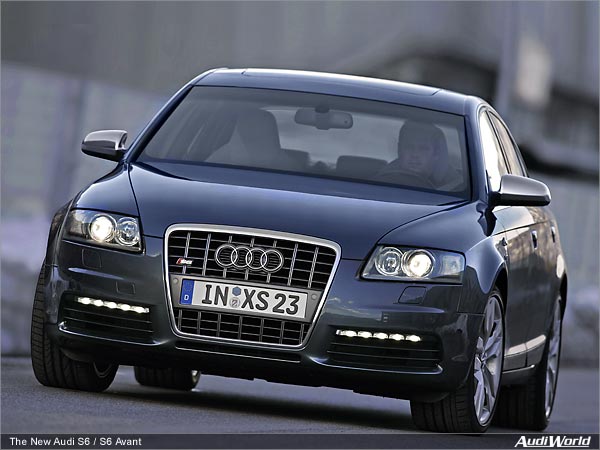
A refined flow of power in conjunction with superlative comfort and an elegantly understated appearance: this is the new Audi S6 / S6 Avant. It is the sporty top model in the luxury-class family of models comprising the Audi A6 saloon and A6 Avant, which took the market by storm following their launch in 2004 and have since garnered countless accolades worldwide from both customers and experts within the trade. The S6, the latest product to result from the systematic application of Audi’s philosophy of sportiness, will go on sale in the spring of 2006. Its appearance will coincide with the launch of the S6 Avant, the estate-car version that combines the exemplary versatility and variability of an Avant with the decidedly sporty character of the new Audi S6. In response to the challenge to deliver supreme performance that always remains perfectly under control, the new Audi S6 will be powered by a completely new ten-cylinder V-configuration engine. This engine, a virtually identical version of which is likewise fitted in the new Audi S8, makes maximum use of its resources: with a displacement of 5.2 litres, it mobilises an output of 420 bhp (309 kW) at 6,800 rpm. It reaches its peak torque of 540 Nm between 3,000 and 4,000 rpm. Between 2,500 and 5,500 rpm, torque of over 500 Nm is available. This engine, weighing only 220 kilograms, is thus able to guarantee superior pulling power in every driving situation. FSI petrol direct injection, a principle that has proved its worth in the most successful racing car ever built, the Le Mans winning Audi R8, plays an instrumental role in this model’s refined flow of power. The saloon is capable of racing from 0 to 100 km/h in 5.2 seconds (S6 Avant: 5.3 seconds); the top speed is electronically governed to 250 km/h. Both the driveline and the steering and suspension have been modified to reflect the immense power potential of the new Audi S6. The six-speed tiptronic automatic transmission, supplied as standard, accomplishes swifter gear changes; the steel-spring suspension is configured for greater agility and a more direct response, as is the servotronic steering. The latest-generation quattro permanent four-wheel drive with a 40:60 torque split naturally ensures optimum propulsion in all conditions. Thanks to this concept, the new Audi S6 sets itself apart as the progressive alternative to all its competitors. One of the key requirements in the development of the Audi S6 was to provide a high standard of comfort in every situation, for all its sporty emphasis. This vehicle consequently also demonstrates over long distances that there is no inherent contradiction between refined power and the scope for the driver and passengers to enjoy a highly relaxing form of travel. The interior offers a luxurious atmosphere. It features, for instance, new sports seats complete with integral head restraints, exclusive leather/Alcantara upholstery on all five seats and deluxe automatic air conditioning plus, with separate temperature distribution for the driver’s and front passenger’s sides. For all the uncompromising and methodical nature of the technical concept, the external appearance of the Audi S6 is decidedly understated and elegant. The The two daytime running light strips, each comprising five LEDs, are both a trendsetting safety element and an innovative masterstroke of design; they are integrated into the front bumper and, when switched on, serve as an unmistakable distinguishing feature of the S6.
|
||||||||