|
|||
|
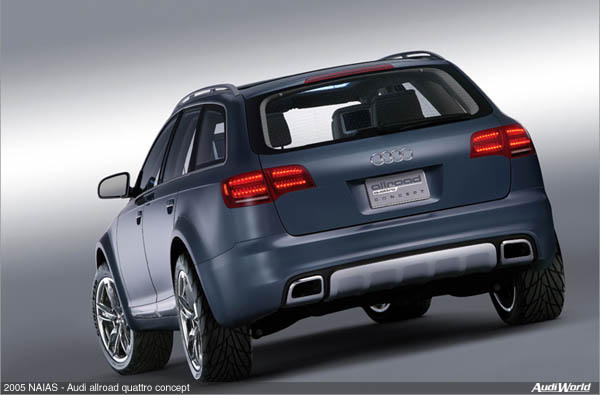
Driving dynamics and ride comfort The dynamic chassis and suspension of the Audi allroad quattro concept is based throughout on sporting, proven technology, featuring an enhanced four-arm front axle in typical Audi configuration and the track-controlled trapezoid-arm rear axle carried over from both the Audi A8 and the A6. Technology of this kind ensures a standard of driving behavior unparalleled in its dynamics and setting the benchmark also in terms of easy control on rough terrain. Ease of control is also ensured by servotronic speed-related power assistance featured as standard and adding even more sensitive steering precision to the already precise handling of the allroad quattro concept. Complete with adaptive air suspension The first-generation Audi allroad quattro already provided clear proof of the all-round qualities of Audi's air suspension system. Now the allroad quattro concept, like the current A6 and A8, features the latest generation of adaptive air suspension for an even higher standard of perfection on the road. Indeed, this combination of air suspension and electronic damper control offers the perfect synthesis of truly sporty handling and supreme suspension comfort. And as an essential point on an off-roader, ground clearance is variable to four levels ranging from a minimum of 160 millimeters to a maximum of 210 millimeters. Via the central Multi Media Interface (MMI), the driver can choose among three different suspension settings ranging from the very sporty to comfortable. The automatic mode provides the perfect all-round set-up, lowering the body of the car by 20 millimeters at a road speed of 120 km/h versus the normal ride height of 180 millimeters. This change in the ride level not only lowers the center of gravity, but also helps to minimize air resistance at high speeds and reduce fuel consumption accordingly. The comfort setting provides gentle spring action and superior long-distance comfort. In this case the car is not lowered as a function of speed on fast roads and highways. Suspension performance in the dynamic mode is comparable to that of a sports suspension, keeping the entire car 20 millimeters lower at all times. Following the request of the driver, adaptive air suspension serves additionally in the lift mode to consistently maintain maximum ride height of 210 millimeters for enhanced safety and handling on rough terrain. At a speed of more than 100 km/h, the vehicle is then lowered automatically to its normal level. Pressing a button next to the instrument cluster, the driver is also able to choose his ground clearance manually on four different levels. In that case the automatic control mechanism will only intervene if the ride height - and, as a result, the center of gravity - chosen endangers the standard of driving safety. The continuously variable dampers are adjusted automatically to the route profile and the driver's style of motoring in all selection modes and ranges. Body level is kept consistently at the same point regardless of the load the vehicle is carrying by means of full-bearing air springs both front and rear. A further special feature of air suspension specific to the system is that the occupants enjoy the same high standard of vibration control at all times, again regardless of the load the vehicle is carrying, with spring firmness consistently adjusting to the overall weight of the vehicle.
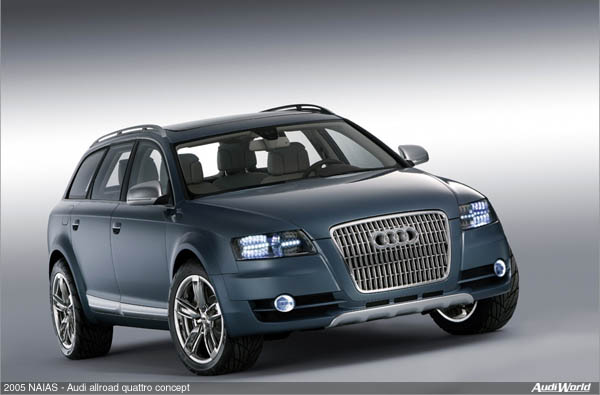
Driver assistance systems Serving as a spearhead in technology, the Audi allroad quattro concept highlights a number of systems destined to enter series production in just a few years and staking out new terrain particularly in the area of vehicle safety. Audi road vision Audi road vision, an unprecedented sensor system recognizing the type of road and surface conditions, ensures a quantum leap in active driving safety: The system not only informs the driver on potentially critical conditions such as gravel or black ice, but also gives the ESP electronic stabilization program and the adaptive cruise control additional, crucial parameters for even better proactive control. Audi road vision combines laser and infra-red spectroscopy to scan the road in front of the vehicle. In the process the frequency-optimized LEDs in the headlamps serve as an infra-red light source, sensors behind the windscreen monitoring the light beams reflected by the road and modulated in each case by characteristic features. This enables the system not only to distinguish between wet, dry and ice-bound roads, but also to recognize road surfaces with specific grip such as concrete, various types of asphalt, or gravel. These two separate units are even able to distinguish between different road conditions to the left and right. The driver is informed of possible risks via the instrument cluster. In addition, ESP is able, for example on road surfaces with poor grip, to intervene within fractions of a second and vary drive or brake forces as required before the vehicle becomes unstable.
Audi lane assist Audi lane assist is a driver assistance system efficiently informing the driver as soon as he unintentionally leaves his lane by inducing vibrations on the steering wheel. This gives the driver very helpful support above all on long, straight-ahead routes like the Interstate, where it is very easy to lose attention. This helpful function is provided by a forward-looking video-camera fitted on the upper windscreen frame and focusing on the usual lane marking lines to be found on most Interstates and expressways. And with the exception of very bad conditions - snow or heavy rain - the system works both during the day and at night. The driver is able to activate or deactivate the system manually simply by pressing a button on the direction indicator lever. Whenever the system is active, vibrations induced intentionally on the steering wheel unit will inform the driver immediately he threatens to leave his lane. Operating the direction indicator briefly before changing lanes, the driver automatically deactivates the system for a short period while changing over to the next lane. The system switches off automatically at speeds below 60 km/h, on very narrow or winding roads, when passing a construction site or roadworks, and on routes without lane marking lines. In each case the driver is informed by a signal in the instrument cluster.
Audi side assist Incorporating radar sensors, Audi side assist monitors areas next to and behind the car to warn the driver - in addition to the image in the rear-view mirror - of vehicles approaching his car. The sensors themselves have a range behind the car of up to 50 meters, also covering the blind angles the driver cannot see next to the car. Audi side assist is activated and deactivated at the touch of a button and operates as of a speed of 60 km/h. The warning signal is provided by a special light element in the exterior mirrors operating in two stages: Audi side assist does not intervene in the actual driving and control functions. | ||||||||||||||||||||||||
| Terms of Use Privacy Policy| Copyright © 1996-2012 by AudiWorld. All rights reserved. |