Test Driving the Audi Q7: Vehicle Durability Test from Southern Africa to the Nürburgring
 |
|||
|
|
|||

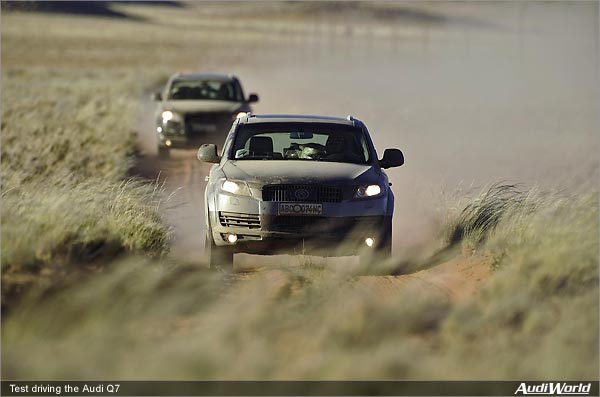
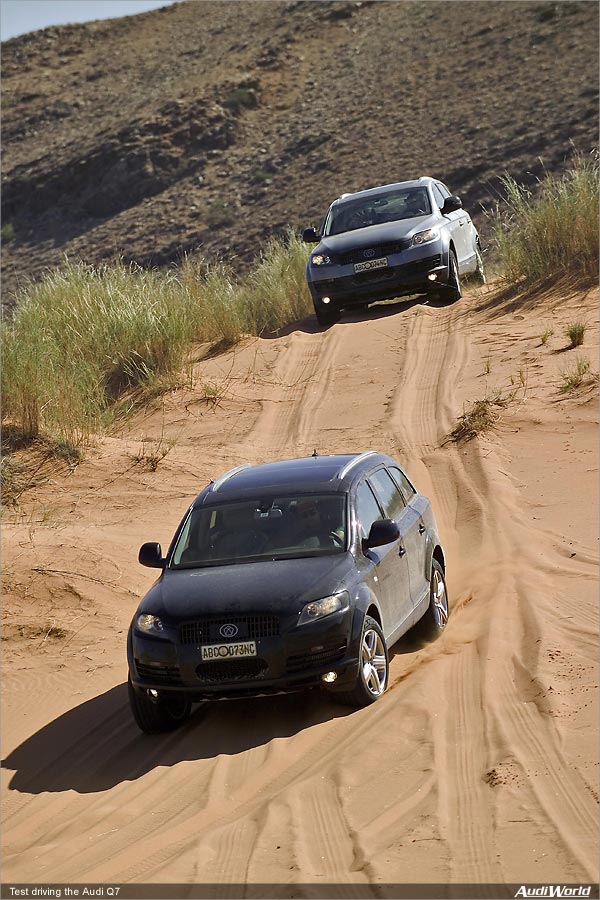
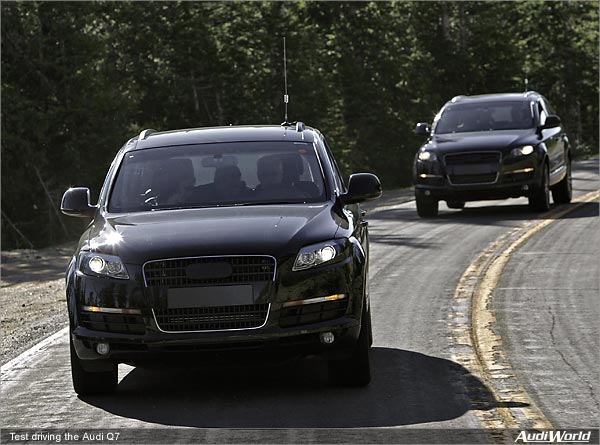
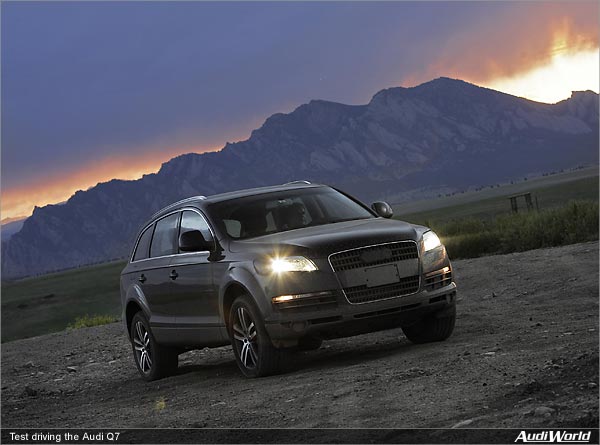
“We’re putting the Q7 through just about every horror imaginable to a car driver.” This is the rather vivid description offered by Martin Brand, Head of Durability Testing at AUDI AG. Franciscus van Meel, Technical Project Manager responsible for the development of the new SUV is certain that, “never before has a vehicle had to go through such a broad-based spectrum of tasks and operational conditions during testing.” Before the first series production models are delivered to customers this coming spring, Q7 prototypes and pre-production vehicles will have been put through millions of test kilometers. Checks are being carried out on a vast array of test beds, on Volkswagen Group proving grounds, at minus 35 degrees Celsius inside the Polar Circle, in the scorching desert heat of Southern Africa, on the highways of Florida, on dust, grit and gravel in Europe, Asia, Brazil and Central America, through to the grueling Nordschleife of Germany’s Nürburgring. But this is not all. The Q7 is also being put through its paces on lonely, winding country roads, on autobahns and in the midst of heavy city traffic in congested urban areas. For over two years now, disguised Q7s have been out and about on public roads, as well as in the most remote corners of the earth, under extreme dynamic, climatic and topographic conditions.
Van Meel identifies the reasoning behind this test of automotive toughness, “An SUV has to be able to perform on the road as well as off of it, and to meet stringent customer expectations. Our comprehensive test program, which is unique in its extensiveness, guarantees that the Q7 will fulfill the very highest expectations in terms of reliability, durability, robustness, stamina, speed, handling, comfort, flexibility and everyday usability.” The durability testing chief affords a glimpse into the test catalogue, “The test tracks we use are a collection of the world’s worst driving and obstacle routes imaginable in customer operating scenarios – pot holes, rough cobblestones, speed bumps, undulations, grit, non-surfaced roads, gravel, rough rock trails, railroad crossings, water obstacles. These are highly dynamic courses, on which driveline, body torsion and bending, as well as running gear durability and functionality are tested.” says Brand. In addition to that, the Q7 has to prove itself as a towing vehicle. If the vehicle withstands all this, then it will also take anything the customer can throw at it. One comparative figure supports the severity of these tests – 8,000 kilometers run on this test cycle is equivalent to 300,000 kilometers of normal everyday use. On top of all this, the engineers from Corrosion Protection Development also have their turn with the Q7. In Audi’s Corrosion Protection Centre, prototypes undergo the so-called INKA test (Ingolstädter Korrosions- und Alterungstest, Ingolstadt Corrosion and Ageing Test). This simulates a 12 year vehicle life within just six months. Hydropulse equipment pummels the vehicle under ice cold conditions, after which it is exposed to extreme sunshine in a climate chamber. The Q7 must then withstand hours of salt water spray in a salt spray chamber. Drives through pits of mud and salt water, as well as stone chip tests on gravel tracks, also seek out every last weakness that could possibly be an entry point for rust. The off-road handling of the Q7 is tested on a special off-road track. The focus of this particular program is on the degree of axle articulation, as well as on handling on steep inclines and in deep water.
A special dust track in southern Europe is the location for checking cabin sealing. Furthermore, the interior of the closed vehicle must withstand extreme temperatures over a period of months in the scorching desert sun in order to test the quality of the materials utilized inside the cabin. What goes for sealing against dust, must also, of course, apply to water. A test chamber in Ingolstadt is designed specifically for this purpose. It enables vehicle developers to specify precipitation ranging from a light shower to a tropical monsoon. The vehicle can also be inclined by up to 30 degrees in order to identify any points through which water can find entry into the cabin. A test hill facilitates checks on pulling away with and without a trailer on inclines of up to 35 percent, while the driveline is put through a host of high speed tests on the speed track. Speaking of high speed, the Q7 has to prove itself on the world’s toughest race track – the Nürburgring’s Nordschleife. This is where Audi handling engineers, mechanics and supplier representatives spend 13 to 14 weeks a year pushing the SUV to its limits. The 20.8 kilometer Nordschleife, with its 33 left and 40 right bends, offers the best possible route profile for optimizing handling (running gear, steering, wheels, tires, shock absorbers, springs and bearings) and braking, as well as vehicle comfort characteristics in extreme situations. It is also perfect for fine tuning the Q7’s sporting character. In so doing, the test vehicles rack up almost 250 laps, or around 5,000 kilometers, on legendary track sections such as the “Caracciola-Karussell”, the “Brünnchen” and the “Planzgarten”.
An equally important element of test driving is the general testing. This covers the functional verification of all the Q7’s electronic features – from engine and transmission electronics, park assist and reversing camera, through to the lighting on the vanity mirror in the sun visor. In so doing, all functions are put under the microscope in the most diverse operating conditions. The drivers are largely on the road at night, in order that the team is able to analyze test results during the day. The majority of these test drives, including all stress tests, are carried out on the Audi proving grounds close to Ingolstadt. The program also includes, however, evaluation drives on public roads, with preferred test areas being centers of urban population. These locations are often subject to the effects of extensive radio interference and highly concentrated mobile communication networks. These evaluations help to establish whether such disruptive signals have a negative effect on vehicle electronics. [1] [2] |
||||||||||||||||||||||||