The Sportiest Midsize Saloon: The Audi A4
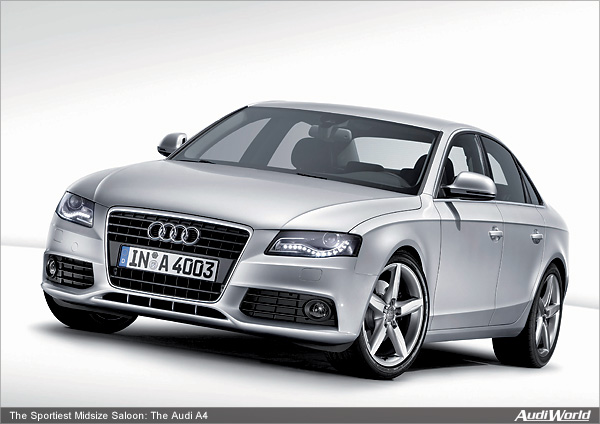
Audi opens up new horizons. The A4 is a sporty car with superb presence on the road; it takes Audi forward into a new dimension on the midsize car market. The engines that power the saloon, both TDI and spark-ignition, in all cases with direct fuel injection, combine effortless power with high efficiency. The dynamic running gear and the use of many technologies taken direct from the large-car category are evidence of the brands lead in technical know-how. The new Audi is a new way to drive. It will reach the market at the end of November 2007, at a basic list price of about 26,000 Euros in Germany. Design The new Audi A4 has many fascinating sides to its character, all of them expressed by the outlines of its body. Their high-tech precision clearly demonstrates the leading position that Audi occupies in automobile design. The new A4 has a spacious saloon body and a firm, muscular stance on the road. Its length (4703 millimetres) and width (1826 millimetres) exceed those of its core competitors, and sporty dynamics were the guiding principle in its development. The proportions have a new balance compared with the previous model: the front body overhang has been considerably reduced and the bonnet and wheelbase are now noticeably longer. A long, coupe-style roof line emphasises the flowing silhouette. The roof meets the side sections of the body at an almost invisible zero-gap joint just one of the many details that uphold the Audi principle of high technical precision. Dynamic balance interplay of body lines The completely new outer body panels of the A4 consist of sculptured, curving surfaces framed by sharply defined outlines. The dynamic line above the door sills rises slightly to the rear, the tornado line below the windows slopes down. In this way the two contours add profile and dynamic balance to the sides of the car. Large wheels and boldly styled wheel arches emphasise this impression of concentrated energy. The new A4 is a car that presents a confident personality to the outside world an impression borne out by the broad, low, sporty single-frame radiator grille. The optional-extra xenon headlights are technical works of art, with powerful visual accents set by their electrodeposited chrome wings and the standard daytime driving lights. Depending on the lighting technology used, their design differs: in the xenon plus headlights, the daytime driving lights each consist of 14 white light-emitting diodes. The rear end of the body, which tapers strongly inwards, interprets the cars sportiness in a most convincing way. The slim, tapered-off light units create a visual relationship with the road. The exhaust tailpipes are straight even on diesel-engined cars a hint at the powerful character of the TDI engines. A4 models with the sporty S line exterior package differ in certain details, for instance the front air dam. The new Audi A4 can be supplied in 15 body colours a wider choice than that offered by any of its competitors. Body and interior There is ample space for the occupants and their luggage in the light, generously sized interior of the new Audi A4, with its clear layout and attractive styling. Thanks to new high-tech materials and processes, the bodyshell is even safer and more rigid than the previous model, although it weighs significantly less. With a drag coefficient of cD = 0.27, the new Audi A4 has the wind-cheating outlines that make for quiet, efficient travel. Inside the new A4 there is a sense of light and space that would do justice to a car in a much larger category. The saloons 2808-millimetre wheelbase is not only more generous than its core competitors but also distinctly longer than the previous model. The interior is now 20 mm longer and rear-passenger knee room has gone up by a remarkable 36 mm to 908 mm. Headroom and width at shoulder height have also been increased. Every passenger in the new A4 has access to convenient features such as large cup holders and softly upholstered armrests. To sit in the new A4 is to feel comfortable and content from the very first moment on a typical Audi effect. The interior seems to fit the occupants like a well-made sports jacket. Its graphic design, featuring taut surfaces and dynamic lines, conveys precisely the sense of lightness and athletic vitality that is inherent in every aspect of the new Audi A4. The choice of materials, how they are used and how satisfying they feel are factors that delight the senses of those who ride in this new car. Every element reveals the careful attention to detail and the already proverbial striving for top quality that are associated with Audi as a premium brand. The switches, for instance, operate with precisely defined effort and no excess movement; the rotary controls click smoothly into place at each setting. This is the sound of true technical perfection. An optional-extra lighting package adds still more lustre to the interior. The front seats are designed to integrate the driver and passenger perfectly into the sporty ambience. Their height can be varied, and they support and locate the occupants body ideally. The drivers hand instinctively finds the gear lever where it is expected; the position and angle of the steering wheel and pedals seem to have been chosen to suit the drivers very own preferences. The steering wheel can be adjusted by 60 mm in reach and 50 mm in height. As an alternative to manual seat adjustment, Audi can supply electric seat adjustment as an extra, with a position memory function as an additional option. Another optional extra is seat cushion and seat back heating. If the sports seats are chosen, the seat base angle is adjustable, the seat cushion can be extended and electric four-way lumbar support is a standard feature. The new Climatic Comfort seats bring a touch of true large-car luxury to the Audi A4. They are upholstered in perforated leather and have small fans with six speed settings to ventilate the seat cushion and seat back. To avoid the risk of excessive cooling, a heating function cuts in automatically. The Comfort seats are available in a specially perforated version of the Milano leather upholstery, in a choice of four colours. For the standard and sports seats a second type of leather (Valcona) is available, and the sports seats can be obtained with combined Alcantara and leather upholstery. Sporty elegance: colours and materials In every area of its colours and materials, the new Audi A4 pursues a sporty, elegant approach. In addition to the standard decor inlays, an aluminium version and three types of wood that can also be combined with a special aluminium look are available. The sporty S line has a black interior including the roof lining. The boot now holds 480 litres whether the car has front-wheel drive or quattro permanent all-wheel drive. This volume is larger than any direct competitor can offer. The loading height is only 673 millimetres, and together with the flat floor and straight side panels makes the boot extremely practical in use. For larger loads, for instance after major shopping trips, the rear seat back can be folded down in two sections, thus increasing the load volume to a maximum of 962 litres. A load-through facility with detachable ski sack can be ordered as an optional extra. On every new A4, the boot lid can be released in three convenient ways: by radio signal from the remote control, with a pushbutton on the drivers door or with the electric soft-touch release in the boot lid handle recess. The lid then swings up automatically on its new hoop-pattern hinges; only slight effort is needed to close it. Weight-saving steel construction the body The technical features of the steel bodyshell are also evidence of the major steps forward that have been taken on the new Audi A4. The body is extremely light in weight: although almost twelve centimetres longer and over five centimetres wider than its predecessor, the bare bodyshell weighs about ten percent less an excellent starting point for a saloon car of low gross weight. The Audi A4 1.8 TFSI, for instance, tips the scales at only 1,410 kilograms. This weight saving is due to specific use of new grades of steel that combine exceptional strength with low weight. Only these ultra-high-strength steel grades give the body the high level of rigidity needed for precise, sporty handling and excellent ride comfort. Audi is the first automobile manufacturer to produce these tailored blanks, as they are called, from ultra-high-strength steel in its own factory. They account for 12 percent of the weight of the new A4s bare bodyshell without doors, lids and windows. 18 percent are accounted for by ultra-high-strength steel grades, 32 percent by high-strength steels and 38 percent by conventional deep-drawing grades of steel. The complex body structure is designed to suppress vibration to the maximum possible extent. Areas at the front end of the car that could be subjected to severe sources of potential vibration as the car is driven have been specifically reinforced, and the larger cavities in the body, including posts and sills, have been divided up into smaller volumes by means of bulkheads. The occupants are protected as far as possible from the effects of collisions of all kinds by carefully matched body elements. For its occupant protection concept, Audi makes use of a number of sources including the large database that it has compiled itself: the Audi Accident Research Unit (AARU) investigates and analyses accidents all over the world. One of its findings is for instance that persons of smaller stature are still exposed to greater risk of injury in a frontal crash than others. For this reason, Audi has coordinated the network of occupant restraint systems more closely than has ever been the case in a midsize car. Sensors on the seat rails determine the actual position of the seats. This data is supplied to the control unit that regulates the action of the adaptive seat belt force limiters and airbags. In this way the distance available for the belt and airbag to restrain the upper part of the seat occupants body can be used as effectively as possible. For every eventuality six airbags as standard equipment Six airbags are installed in the new Audi A4 as standard, with two more as an optional extra for the outer rear seats if required. Isofix child seat mountings at the rear are another optional extra, and are also available for the front passenger seat, in which case its airbag is de-activated. The front seats and head restraints are designed to support their occupants safely if the car is involved in a rear-end collision. The new A4 is one of the first cars to comply with all the new legal requirements in Japan and Europe regarding a collision with a pedestrian. It is also well equipped to withstand minor impacts with solid objects or other vehicles at speeds up to 15 km/h without damage to the main body structure. The new Audi A4 cleaves the air ahead of it smoothly and quietly, like a large luxury car, thanks to careful attention to detail design in the aero-acoustic wind tunnel. The drag coefficient (cD) of the basic version is only 0.27. Depending on which engine is chosen, the overall aerodynamic drag is between three and five percent lower than the equivalent preceding models, although the frontal area of the new, wider body has gone up from 2.14 to 2.19 square metres. Good airflow around the body is aided by an almost complete undertray.
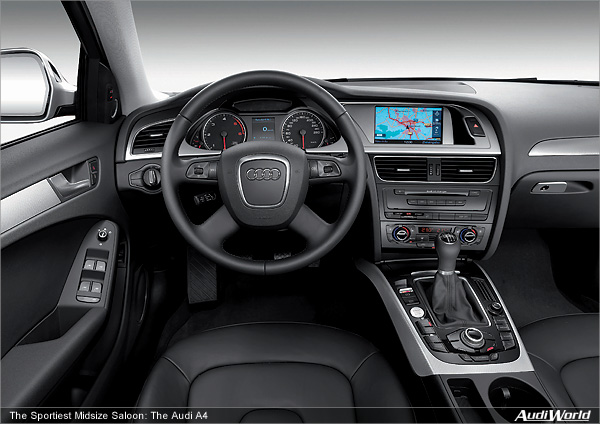
Controls Optimal car control is one of the major areas of competence in which Audi leads the way. The new A4 is convincing in its ergonomics, which are logical in every detail and permit the controls to be operated intuitively. The cockpit in the new Audi A4 is clearly oriented toward the driver. The centre console is inclined at 8 degrees to the drivers side of the car and forms a single visual unit with the instrument panel. A multifunctional leather-covered sports steering wheel with three spokes is available as an optional extra. It has small drum-type and pushbutton controls for the basic functions of the navigation and audio systems, the car phone and the voice control system. For the A4 with automatic transmission, shift paddles behind the steering wheel rim are another optional extra. In many aspects of its detail design, Audis new midsize saloon pursues the same approach taken on the A8, its larger sister-model in the luxury segment. The Driver Information System (DIS) display located between the speedometer and revolution counter dials is a standard item on cars with a V6 engine. A 6.5-inch black-and-white display screen is located on the upper part of the centre console, where it can also be clearly seen. It supplies information on the audio and air conditioning systems and the settings possible when the CAR menu is selected. These settings enable customers to configure many of the cars functions themselves. The large switches and pushbuttons on the standard audio systems with MMI control logic are ideally positioned for easy operation, between the automatic air conditioning and the ventilation outlets. When the new Audi A4 is ordered with a navigation system, the Multi Media Interface (MMI) is integrated into the centre tunnel. MMI has been highly praised by testers on many occasions and has proved to be superior to systems offered by competitors. 15 large switches and a volume control are grouped around a central turn-and-press knob, and used to select the navigation, information, CAR menu, set-up, telephone, address book, CD/TV and radio functions effortlessly, intuitively and logically. If the car has the high-end navigation system with DVD drive, all the relevant information appears on a colour screen measuring 7 inches from corner to corner. Driving off safely and smoothly: the electro-mechanical parking brake Another control on the centre tunnel operates the electro-mechanical parking brake, a convenient luxury feature also derived from the Audi A8. It assists the driver when the car is moving away from a standstill, and also functions as an emergency brake. The optional-extra Audi hold assist adds extra functions. The space formerly occupied by the handbrake lever can be used for additional convenience: as an optional extra, a centre armrest with extra-soft upholstery can be installed, with two 12-Volt power sockets beneath it. The new radio-operated key for the Audi A4 has no conventional blade: to start the engine, the key is simply pressed into the ignition switch. It can memorise several of the cars specific settings and also store servicing information and fault messages. The advanced key high-end version means that the key does not even have to be taken out of the drivers pocket. In this case sensors are used to lock and unlock the car and the engine is started and stopped by means of an elegantly designed pushbutton on the centre tunnel. Audi supplies various stages in headlight technology. In the top version, the xenon plus headlights can be combined with adaptive light, which directs the headlight beams in the appropriate direction as the car turns a corner. The new A4 is supplied with automatic air conditioning as standard equipment; the system is an entirely new, more efficient development that has enabled cooling performance to be increased by 10 percent and at the same time the fuel consumed to operate the air conditioning has been reduced by 20 percent. As an optional extra, a version with three temperature zones can be ordered; it permits separate control of temperature and airflow for the driver, front passenger and rear passengers. Page: [1] [2]
|