
Audi Unveils RS 3 competition limited: Ultimate RS 3 Signals Likely End of an Era
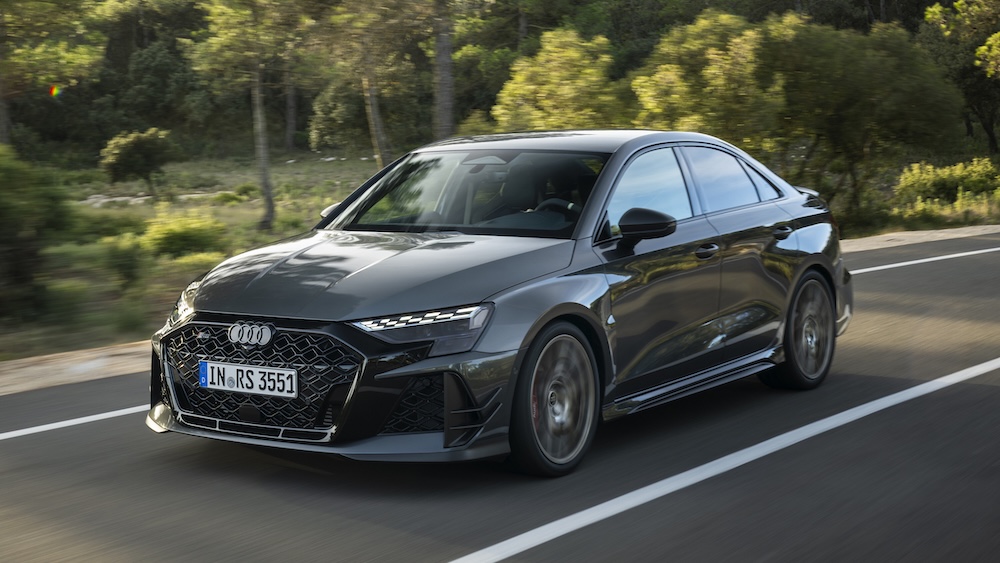
Will the exclusive 2026 RS 3 competition limited be worth paying almost double the base price? Only collectors will truly know.
Audi has trotted out a new limited edition RennSport model with a coilover suspension, which typically signals two things. First, we’re about to see, in this case, the very best Audi RS 3 to have ever attacked a road course… And, second, it probably means we’ll soon say goodbye to this generation RS 3. Will the 5-cylinder internal combustion motor survive past this generation at a time when emissions regulations are rising, and the Volkswagen group is planning massive cutbacks? We could only speculate. But for this fine day, we’re here to celebrate the forthcoming 2026 Audi RS 3 competition limited (<– don’t you dare capitalize the C and the L or Ingolstat will be upset).

To commemorate (oh my God, I’m getting old) 50 years of Audi 5-cylinder greatness, Audi’s engineers and designers have concocted what may arguably become the most capable street-legal Audi 5-banger of all time. Regulated to just 750 examples worldwide, the RS 3 competition limited (RS3CL) takes the already capable RS 3 with the Dynamic Plus Package and Sport Exhaust and elevates the interior, exterior, and suspension while highlighting all the features we’ve come to love over the last few model years.
What’s New & Exclusive

Sorry, America, no Sportback for you!
Starting with the exterior, the new RS 3 competition limited features a revised front lip with two pairs of canards to reduce front-end lift. Also out front, you’ll find darkened matrix LED headlights that illuminate in a 5-cylinder-firing-order 1 -2 -4 -5 -3 pattern when you unlock or lock the car. The Sportback (aka wagon) variant, which has never been offered in the U.S., also gets an extra rear spoiler akin to last year’s RS 6 GT.

The RS3CL — which will only be offered in Daytona gray, Glacier white matte, or the exclusive Malachite green — also features heritage RS badges front and rear as well as several pieces of matte carbon fiber, including the mirror caps, side skirts, rear spoiler, and trim above the rear diffuser.

But the absolute visual showstopper of this new RS 3 has to be the new 19″ ten-cross spoke wheels, which are finished in a stunning Neodymium gold matte color.

Audi’s made some banger wheels over the years, but wow…

Moving onto the RS3CL’s interior, you’ll find an exclusive color scheme that mixes Black (yes, including piano black, sigh), Neodymium gold, and Ginger white, not to mention RS 3 competition limited door projections and front seat badges. The RS bucket seats also feature black leather bolsters with Neodymium gold dinamica microfiber inserts, Ginger white contrast stitching, and matte carbon backs. (Worth noting: sometimes the U.S. market doesn’t get the same seats as Europe, so stay tuned.)

The Gold and White elements carry over onto various armrests and the back seats. Other unique elements include the Ginger white seat belts, matte carbon quattro badging on the passenger dash, and white (digital) gauges in honor of the 1994 RS2.

Lastly, the flat top-and-bottom steering wheel features Ginger white stitching.
The First RS 3 with Factory Coilovers

As we recently saw with the RS 6 GT, no limited edition Audi is complete without a set of manually adjustable factory coilovers that offer a truly unique and exclusive driving experience. So, what’s so special about these shocks?

The new RS3CL’s coilover system features twin-tube, three-way adjustable shocks all the way around, as well as a stiffer rear stabilizer and stiffer rear springs. Up front, the system uses stainless steel shock bodies with external reservoirs, which are designed to reduce heat while being driven aggressively. Out back, the aluminum shocks feature a larger diameter and thicker piston rods compared to the standard RS 3’s suspension.
But what are three-way adjustable shocks, you ask?

These are coilovers that have adjustable nobs for low-speed compression (12 steps), high-speed compression (15 steps), and rebound (16 steps). Compression refers to the moments when a shock shortens (or compresses), such as when you hit bumps in the road. Rebound refers to the way shocks return to their original length. Low-speed adjustability helps drivers dial forces that affect things like grip, for improved cornering. High-speed adjustability deals with sudden, high impacts like bumps in the road. And rebound adjustability affects how the car reacts after hitting a bump.
By fiddling with these adjustment settings, you can make the RS3 competition limited feel like it’s on rails — with precise and direct handling — or lean more toward comfort and compliance. Each RS3CL will include an instruction manual and the tools required for dialing in its coilovers.
What Appears to be the Same

While Audi’s engineers and designers have set out to create a truly exclusive and iconic RS 3, the base drivetrain, exhaust, and braking systems appear to be unchanged. This includes a 394-horsepower variant of the 2.5L turbocharged 5-cylinder engine, which also boasts 369 ft.-lbs. of torque. Paired with a 7-speed dual-clutch transmission, the RS3 competition limited boasts a top track speed of 180 mph, and a 3.6-second 0-60 mph time.

Similarly, the RS3CL includes standard carbon ceramic front brakes (available on the Dynamic Plus package on the base model) with red calipers and Pirelli PZero Trofeo R semi slicks, not to mention the standard RS Sport exhaust that, in modes like Dynamic, RS Performance, and RS Torque Rear, opens up a little early so you can enjoy some worbling 5-cylinder turbo greatness.

Speaking of RS Torque Rear, the RS3CL boasts, of course, the RS 3’s incredible torque-splitting rear differential that uses a series of clutches and wheel braking to divert torque and power to where the driver needs it most. In certain modes, that means overdriving the outer rear tire to provide understeer-defeating traction. In RS Torque Rear, lovingly referred to as drift mode, it means you can roast horrifyingly expensive tires and rotate in what feels like a cheat-code level of drifting control.

So, on one hand, when you see the price in the next section, you may be slightly disappointed that the RS 3 competition limited is packing a lot more firepower for this amount of required cash. And, yet, why fix what’s very far away from being broken? (Plus, European emissions are sadly strict as hell.)
Pricing & Availability

As is the case with many global launches, Audi USA has yet to chime in with exact pricing and allocation figures for the North American market. But here’s what we know:
Audi expects to start delivering the RS 3 competition limited in mid-2026, with Sportback pricing in Germany starting at 108,365 euros, and the Sedan starting at 110,005 euros. As you probably know, the U.S. won’t get the Sportback, but based on German pricing, the sedan should start around $127,910. Although, with America’s ever-changing tariffs, who knows where that ends up.
For reference, base pricing for the standard 2026 RS 3 starts out at $67,395 (including destination), with fully loaded examples topping out a little over $78,000. Which means you’re looking at spending over $50 grand more for a one-of-750 limited edition RS 3 compared to a similarly equipped model.
Is it worth it? Only collectors and maybe a few journalists will ever know.

Also worth noting, Audi produced 660 RS 6 GT models, the last limited edition with coilovers, and 80 of those came to North America. With 750 RS 3 competition limited’s planned, we can hope there are at least 100 examples heading this way.
Images: Audi global, European models shown

You must be logged in to post a comment.